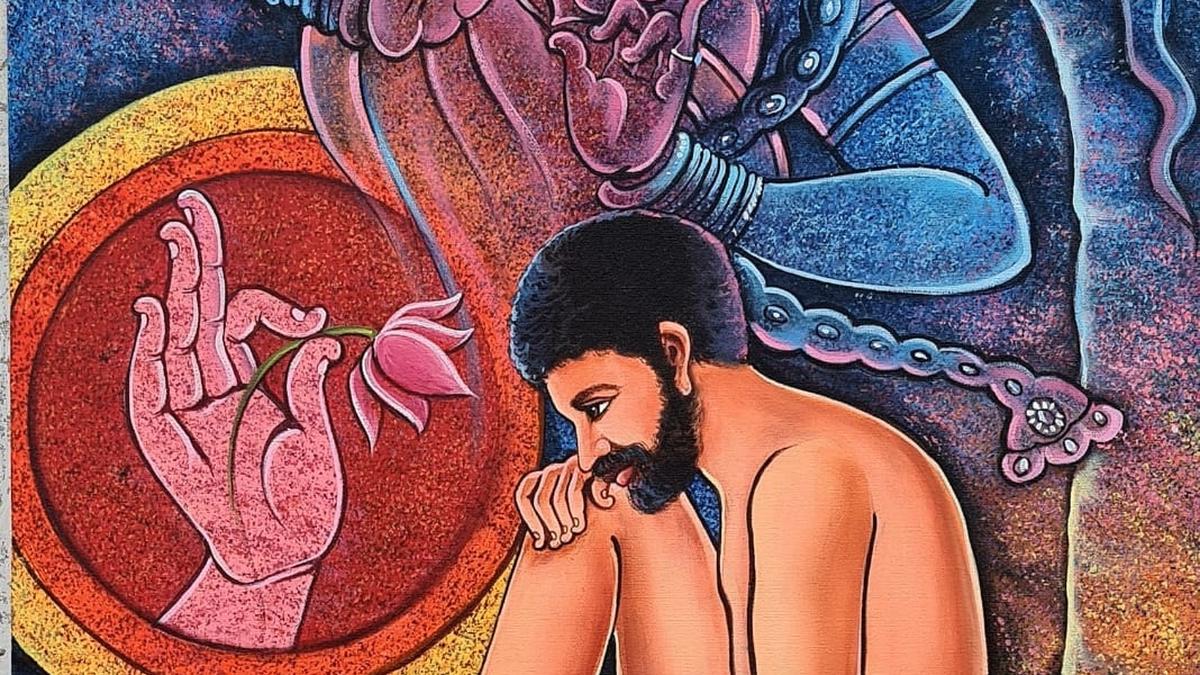
Kumaragiri Vema Reddy popularly known as ‘Vemana’ was a Telugu poet. His poems were written in the popular vernacular of Telugu, and are known for their use of simple language and native idioms. His poems discuss the subjects of wisdom and morality. He is popularly called Yogi Vemana, in recognition of his success in the path of Yoga. There is no consensus among scholars about the period in which Vemana lived. C.P. Brown, known for his research on Vemana, estimates the year of birth to be the year 1652 based on some of his verses.
Vemana was the third and youngest son of Gaddam Vema, then the king of Kondaveedu in present-day Andhra Pradesh. He was named Vemareddy after his father. Vemana came into contact with Lambika Shiva yogi in Kondaveedu, who initiated him into the path of Yoga. After this, Vemana travelled across the state, composing poetry and attaining success in yoga.
Vemana composed numerous poems in the vernacular of Telugu. His poems are four lines in length. The fourth line is, in majority of the cases, the chorus ‘Viswadabhirama Vinura Vema’ – he thus conveyed his message with three small lines written in a simple vernacular. He traveled widely across south India, acquiring popularity as a poet and Yogi. People really took to Vemana’s poems owing to their simple language and sweet message. So high was the regard for Vemana that a popular Telugu saying goes ‘Vemana’s word is the word of the Vedas’. He is celebrated for his style of Chaatu padyam, a poem with a hidden meaning.
Charles Philip Brown (C.P. Brown – 1798 – 1884) translated most of Vemana’s poems into English in 1839. A large selection of his poems are a part of the present High School curriculum of Telugu. In his honor, a university is named in Cuddaph ‘the Yogi Vemana University’.
Vemana was believed to have lived for some time in the Gandikota area of Cuddapah. There is a headstone marking the grave of Yogi Vemana in kataru palli (Kadiri Town), a village in Kadiri Taluk, Anantapur district (now called Satya Sai District), Andhra Pradesh. It is believed widely that Vemana died in this village. Being a Yogi, he was buried and not cremated. Many lines of Vemana’s poems are now colloquial phrases of the Telugu language. They end with the signature line Viswadhaabhi Raama, Vinura Vema, literally Beloved of Vishwadha, listen Vema. There are many interpretations of what the last line signifies. Vemana’s poems are in Ataveladi (dancing lady) meter. Look at the following example:
|
Vemana’s Poem in Telugu |
C.P Brown’s Translation |
|
ఉప్పుకప్పురంబు నొక్క పోలికనుండు చూడ జూడ రుచుల జాడవేరు పురుషులందు పుణ్య పురుషులు వేరయా విశ్వదాభిరామ వినురవేమా!
|
Salt and camphor look similar, but closer observation shows their taste is different Among men, virtuous people stand apart Beloved of the Bounteous, Vema, listen! |
Lastly a word about C.P Brown (10th November 1798 – 12th December 1884). He was an East India Company official worked in Andhra Pradesh. Mr. Brown as an official in the region collected, edited and translated Vemana’s works into English. It will not be out of place to say it was C.P Brown who saved the heritage of the Telugu language. The Telugu literature was dying out. The flame was flickering in the socket. C.P Brown found Telugu literature dead and it was he who resurrected it to life. And I do not think we would have found Vemana without C.P Brown.

Dr. K. Raja Gopal Reddy is a seasoned internationally qualified Insurance professional. What you are reading here, may not answer all the questions we have, but has the absolute power of asking unsettling questions which increase the interest in the strange world, and show the contradictory wonders lying just below the surface of the commonest things of life. Look at this disturbing but beautiful thought of Friedrich Nietzsche “God is dead. God remains dead. And we have killed him”.
Dr. Reddy can be reached at: raja66gopal@gmail.com