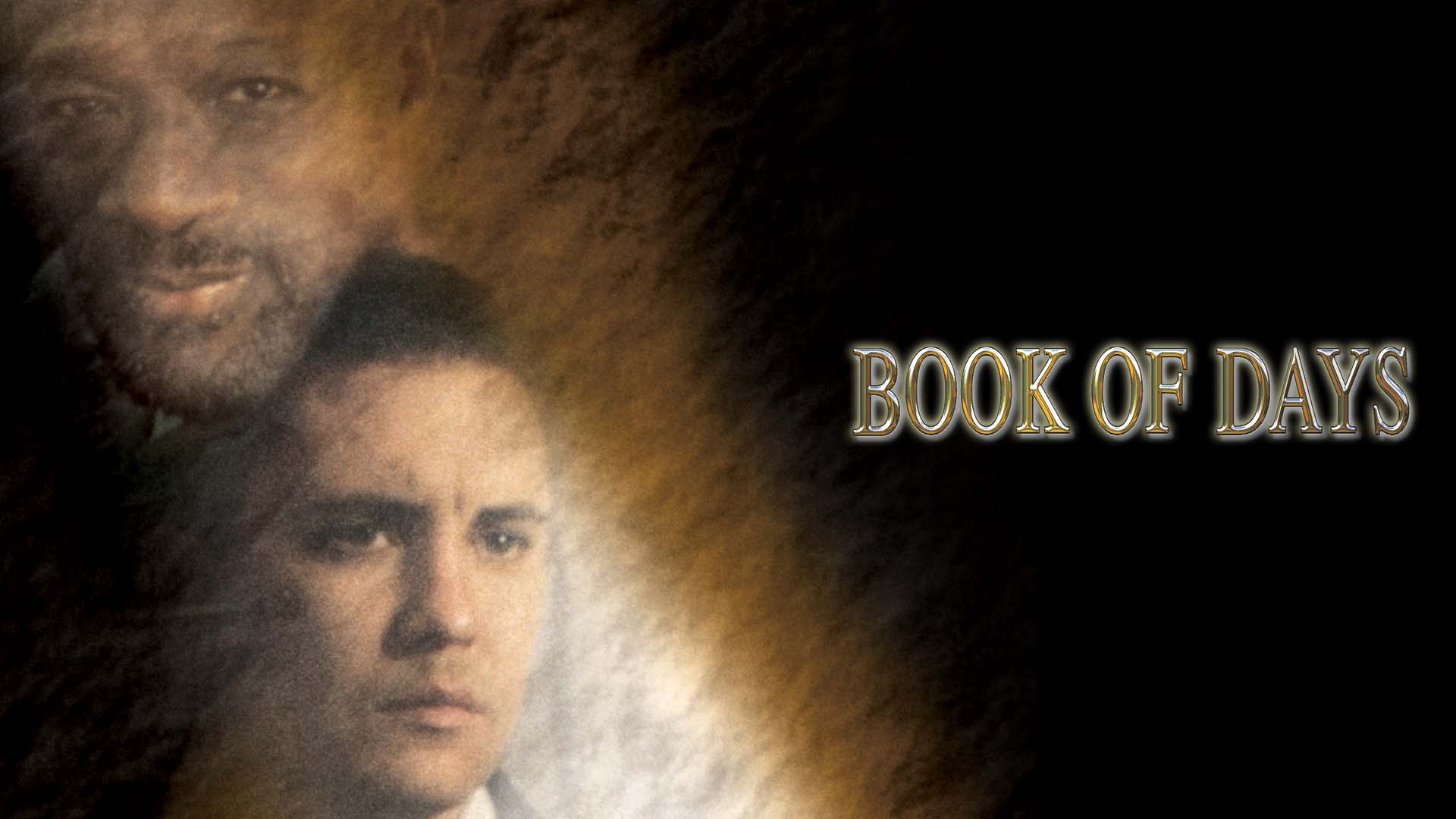
An insurance agent (Daniel Hartland) marries a former nun (Caroline Winters). However, just as they are driving away from the church, a drunk driver rams into their car killing Caroline.
Daniel angrily rails against God, demanding to know why He allowed this to happen. Daniel’s boss Richard Worthington refuses to settle claim on Caroline’s life insurance policy and demands that Daniel return to work and meet the insurance sales quotas. A mysterious deliveryman then leaves Daniel a parcel containing a book called Liber Diei (Book of Days). Daniel and his good friend photographer (Frankie Newhall) discover that the book contains a list of names and the dates upon which each of the people listed is going to die. Daniel uses these to meet his insurance sales quotas. He discovers that his friend, (Sister Grady), is due to die. He intervenes to save her life – only to find that in giving her ten more years he has had these taken off his own life according to Heavenly arithmetic.
Worthington’s son gets hold of a list and reports it to the police who then suspect Daniel of killing the people. However, when Daniel decides to save the life of an elderly man to ‘disprove’ the list to Worthington, the man’s wife dies instead and Daniel is placed on trial. With his mother acting as lawyer to defend him, they fight to stop the knowledge of the Book of Days coming out.
I would not call this as an insurance movie, though there are many references to insurance phrases. I would rather say that this is a Christian movie – made both for Christian audiences and to preach to the secular mainstream. Such movies include films such as Smuggler’s Ransom (2007) and Saving God (2008). These have attempted to employ big stars to sell films with strong pro-Christian messages, although almost all have failed. But all this is changed with the success of Mel Gibson’s The Passion of the Christ (2004) and its demonstration to Hollywood marketers of the existence of a Christian niche market.
Book of Days is one of the good Christian films. It is not too preachy and can be enjoyed simply in terms of its premise instead of as a sermon. There is certainly much mention made of God and quoting of the scriptures throughout. The film is at its best when it comes to plotting convolutions and moral problems – whether to use such a book to aid oneself at work, or indeed whether to sacrifice ten years of your life in order to get oneself out of a difficult situation.
There are some parts that seem strained credibility – Wil Wheaton and Maureen Flannigan experience no amazement at receiving the book, not the least any curiosity who their mysterious benefactor was and why he gave it to them. The chain of events that leads up to Wil Wheaton being charged with murder is highly improbable.
Not to mention the poorly research historic fact – being mentioned that the book was discovered in Gomorrah (which, if it ever existed, was in Jordan sometime around the Early Bronze Age) but then it being written in Latin (a language that was not spoken at least a thousand years later. In Latin, the title ‘Liber Diei’ correctly translates as ‘Free Days’ as opposed to ‘Book of Days’). Book of Days is a modest film – strongly scripted and where the religion forms a part of the plot but is not too preachy. Yes. It does has the insurance twist!
About the Author

Dr. K. Raja Gopal Reddy is a seasoned internationally qualified Insurance professional. What you are reading here, may not answer all the questions we have, but has the absolute power of asking unsettling questions which increase the interest in the strange world, and show the contradictory wonders lying just below the surface of the commonest things of life. Look at this disturbing but beautiful thought of Friedrich Nietzsche “God is dead. God remains dead. And we have killed him”. Dr. Reddy can be reached at: raja66gopal@gmail.com